Panagou, C., & MacBeth, A., (in preparation) Trajectories of risk and resilience.
Adverse childhood experiences (ACEs) are well-known to have life-long and serious consequences. However, not everyone who has experienced adversity in childhood will develop mental health problems later in life, and not everyone will be affected in the same way. With this in mind, in recent years, important efforts have been made towards examining factors that could help researchers understand the link between early life adversities and emotional wellbeing. Such research might help understand why some people thrive despite hardships, while others become more susceptible to poor mental health.
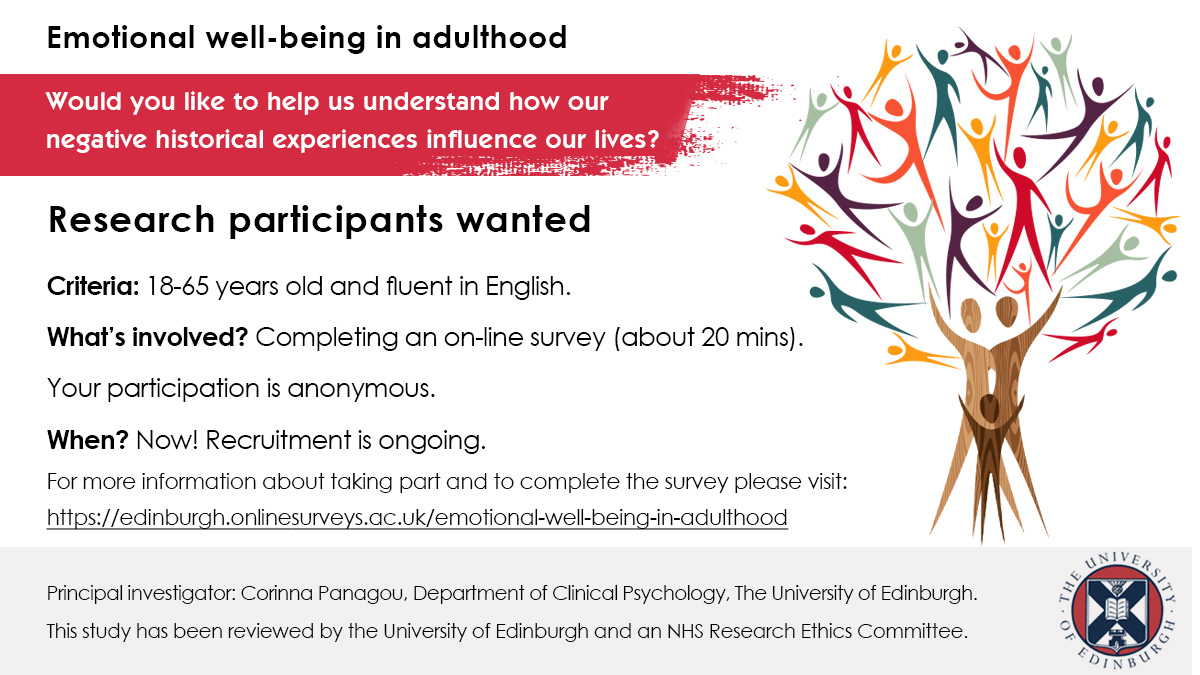
Our study modelled the influence of empathy and perceived social support on mental health outcomes in a mixed clinical and non-clinical population, in the context of exposure to ACEs. N = 575 participants (NHS and community-based sample) aged 18 to 65 completed a battery of self-report measures assessing early adversity, perceived support, empathy and mental health outcomes. The results of the current study reported a high prevalence of ACEs, with about 74% of the total sample reporting a history of adversity. ACEs were found to be associated with higher psychological distress levels. The results of the project showed that people’s beliefs about availability of support and their capacity to respond to other people’s emotional states could potentially help explain the link between early life adversities and emotional wellbeing. More specifically, study findings support the assumption that highly empathic individuals with a history of adversity seem to be particularly sensitive towards other people’s negative affect and may experience self-oriented distress related to the suffering of others. In addition, it was shown that individuals affected by childhood adversity may be prone to experiencing higher levels of psychological distress through perceptions of the availability of support. Study results also revealed that people who experienced emotional neglect when they were children seem to be more driven to empathize with others later in life but their capacity to understand the mental states of others might be negatively affected.
Taken together, despite the significant work in progress related to the exploration of factors affecting the link between adversities and mental health later in life, further research is warranted. Such research is very important as it will help understand better the factors that can potentially promote well-being and build resilience in people who experienced adversity early in their lives.
Dr Corinna Panagou
Clinical Psychologist, NHS
Department of Clinical Psychology, The University of Edinburgh
 Emotional well-being in adulthood